Leave Your Message

Top 10 Modular House Manufacturers for Global Buyers

The global demand for Modular House solutions is moving beyond temporary housing. Buyers now seek durable factories, predictable schedules, and designs that travel across borders.

Grand View Research valued the global modular construction market at approximately USD 91.36 billion in 2022. Its report projects a 7.5% compound annual growth rate from 2023 to 2030. McKinsey & Company also estimated that modular construction could create a USD 130 billion market in Europe and the United States by 2030. These figures are promising, but they do not guarantee quality. Manufacturing capacity, transport access, local building codes, and after-sales support still shape real project outcomes.

Ryan E. Smith, a researcher and author in off-site construction, describes the principle clearly: “Modular construction is a process, not a product.” That distinction matters. A polished showroom may hide weak engineering or limited installation experience. This guide reviews ten Modular House manufacturers for global buyers, using practical criteria such as production capability, customization, certifications, export experience, material quality, and delivery transparency. Company rankings remain partly subjective. No single factory fits every climate or budget.

Some manufacturers excel in steel frames. Others focus on timber systems, volumetric modules, or energy-efficient homes. A coastal project may need corrosion protection. A remote site may require compact shipping dimensions and local assembly training. Buyers should verify current certificates, factory audits, warranty terms, and completed projects before signing contracts. The strongest shortlist is not always the cheapest one. Sometimes, it is the company that communicates limitations honestly.
Top 10 Modular House Manufacturers for Global Buyers

Industry Context: Buildings Produce 37% of Global Energy-Related CO₂ (UNEP)

Top 10 Modular House Manufacturers for Global Buyers

Industry Context: Buildings Produce 37% of Global Energy-Related CO₂ (UNEP)

The modular housing market is changing as buyers examine energy use, construction waste, and long-term operating costs. UNEP reports that buildings produce 37% of global energy-related CO₂ emissions. This figure gives every purchasing decision greater weight. A factory-built home can reduce material waste through measured cutting and controlled production. However, modular construction alone does not guarantee low emissions. Design quality, insulation, transport distance, and energy systems still matter.

For global buyers, the top 10 manufacturers should be assessed through practical evidence, not attractive renderings. Check thermal performance, airtightness testing, moisture protection, and documented material standards. Ask for project references in climates similar to yours. A home designed for a mild coastal region may perform poorly in a cold, humid location. Delivery planning also deserves attention. Oversized modules can require specialized transport, permits, and local lifting equipment. These costs are easy to underestimate. I have found that clear specifications often prevent more problems than impressive promises.

Tips: Request an energy model before signing. Compare heating and cooling demand, not only purchase price. Confirm who handles foundations, installation, inspections, and after-sales repairs. Visit a completed project if possible. Small details matter, such as window seals, roof junctions, and ventilation controls. Some manufacturers may lack complete lifecycle data. Treat that gap as a question, not an automatic rejection. The industry still needs better transparency.

Selection Method: Rank 10 Firms by Capacity, Certifications, Cost, and Delivery

Top 10 Modular House Manufacturers for Global Buyers

Selection Method: Rank 10 Firms by Capacity, Certifications, Cost, and Delivery

A credible ranking begins with verifiable operating evidence, not attractive brochures. We assess ten manufacturers using factory capacity, certification coverage, landed cost, and delivery performance. Capacity includes annual output, production lines, workforce size, and available slots. A large facility means little if schedules remain full for twelve months.

Certifications receive close review. We check issuing bodies, expiry dates, covered products, and destination-country requirements. A certificate for electrical components may not validate the complete dwelling. Factory audits, quality records, and warranty procedures add practical evidence. Buyer references are valuable, especially when they describe winter performance, moisture control, and replacement response.

Cost receives a 30 percent weighting, while capacity, certifications, and delivery receive 25, 25, and 20 percent. We compare comparable floor areas and specifications, then add packaging, freight, installation, permits, and site preparation. Delivery scores reflect quoted lead time, export experience, port handling, and documented on-time results. The method is useful, not perfect. Currency changes, local labor shortages, and weather can distort estimates. A cautious buyer should request a live production schedule, inspection rights, sample contracts, and a written list of exclusions. Small details matter. A missing foundation allowance can change the final budget sharply.

Factory Benchmark: Assess 60–90% Off-Site Completion Potential (McKinsey)

Top 10 Modular House Manufacturers for Global Buyers

Factory Benchmark: Assess 60–90% Off-Site Completion Potential

The 60–90% figure should guide factory audits, not replace them. McKinsey’s modular construction analysis reports potential schedule reductions of 20–50% and cost reductions of up to 20%. However, off-site completion varies by design, climate, transport distance, and local codes.

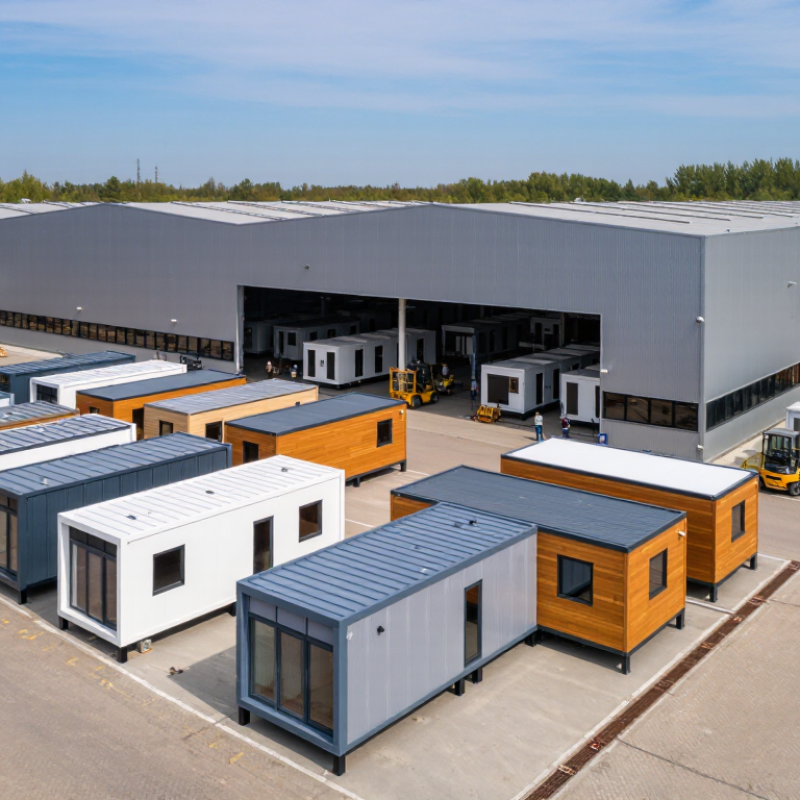
Look beyond showroom photographs. Inspect the production line, welding or fastening stations, moisture controls, and final inspection records. A credible factory should show measurable tolerances, batch traceability, and documented rework rates. Ask how much plumbing, wiring, insulation, cabinetry, and interior finishing are completed before shipment. A module leaving with only structural framing does not represent 90% completion.

The 2023 International Energy Agency buildings report states that buildings and construction consumed about 34% of global energy and produced roughly 37% of energy-related emissions in 2022. Factory production may reduce site waste, but transport and repeated handling can weaken that advantage. Measure both.

Dodge Construction Network’s 2023 SmartMarket research identifies growing use of prefabrication, while also highlighting coordination and logistics as common barriers. The practical lesson is uncomfortable: a high factory percentage can still produce delays. An independent engineer should compare drawings, factory capacity, shipping plans, and installation sequencing. I would treat 60–90% as a testable range, never a guaranteed specification.

Top 10 Modular House Manufacturers for Global Buyers — Factory Benchmark: Assess 60–90% Off-Site Completion Potential (McKinsey)
Benchmark Rank Anonymous Manufacturer Profile Primary System Typical Off-Site Completion Potential Indicative Factory Lead Time Typical Building Scale Quality & Compliance Indicators International Delivery Readiness Buyer Due-Diligence Priority
01 Profile A — High-Volume Volumetric Platform 3D volumetric modules with integrated bathrooms and kitchens 80–90% 8–14 weeks after approved shop drawings Multi-unit housing, hotels, student accommodation Factory production control; documented inspection plans; project-specific structural certification required Strong container, flat-rack and break-bulk planning capability Confirm module dimensions, lifting points, shipping envelope and local code approval
02 Profile B — Panelized Residential Specialist Closed timber or light-gauge steel panels with pre-installed services 65–80% 6–12 weeks after engineering release Detached homes, townhouses, low-rise developments Panelized quality-control procedures; thermal and moisture detailing; local energy-code review required Efficient for flat-pack export and regional assembly networks Verify weatherproofing sequence, panel tolerances and local installer competence
03 Profile C — Hybrid Steel-and-Concrete Producer Steel volumetric modules combined with site-built podiums 70–85% 10–18 weeks after structural approval Mid-rise apartments, workforce housing, healthcare projects Welding traceability; corrosion protection records; fire, acoustic and structural testing required by jurisdiction Suitable for repeatable international projects with engineered logistics Check fire-stopping interfaces and connection design between modules and podium
04 Profile D — Bathroom-Pod and Core-Module Integrator Pre-finished bathroom pods, utility cores and partial volumetric units 60–75% 6–10 weeks for repeat configurations Hotels, apartments, senior living and student housing Plumbing pressure testing; waterproofing inspection; factory acceptance testing Good export fit where local trades complete final connections Validate maintenance access, service compatibility and replacement-part availability
05 Profile E — Premium Timber Modular Builder Engineered timber volumetric modules and panelized hybrid systems 70–85% 8–16 weeks after material procurement Single-family homes, eco-resorts, education buildings Moisture management; engineered timber documentation; fire and acoustic design verification Best suited to controlled shipping routes and protected storage Assess humidity exposure, fire strategy, timber treatment and local insurance requirements
06 Profile F — Light-Gauge Steel Housing Platform Cold-formed steel frames with insulated wall and roof cassettes 65–80% 6–14 weeks after finalized bill of materials Detached homes, social housing and compact urban units Steel gauge and coating records; fastener specifications; thermal-bridge control documentation High packing efficiency for panelized export shipments Check condensation risk, seismic detailing and availability of compatible fasteners
07 Profile G — Concrete Modular Producer Precast or semi-precast concrete volumetric modules 60–75% 10–20 weeks depending on mould availability Apartment blocks, schools, dormitories and public housing Concrete mix records; reinforcement inspection; dimensional and curing controls Most practical for regional or short-sea logistics due to unit weight Confirm crane capacity, road restrictions, foundation tolerances and transport permits
08 Profile H — Compact Export-Home Manufacturer Small volumetric units and flat-pack accessory dwelling units 75–90% 4–10 weeks for standardized models Small homes, cabins, offices and tourism accommodation Standardized product documentation; electrical and plumbing test records; model-specific approvals Strong for containerized shipments and repeat model procurement Review product exclusions, foundation scope, utility connections and climate suitability
09 Profile I — Design-and-Build Modular Contractor Project-specific hybrid modules with factory and site installation services 65–80% 10–18 weeks after design freeze Custom homes, hospitality and multi-building developments Integrated design management; factory inspection hold points; project quality plan Strongest where the contractor manages customs, installation and commissioning Clarify design responsibility, performance guarantees, liquidated damages and handover scope
10 Profile J — High-Spec Smart-Home Manufacturer Volumetric modules with factory-installed controls, lighting and appliances 75–90% 8–16 weeks after equipment confirmation Premium residences, serviced apartments and branded accommodation Electrical test certificates; controls commissioning records; appliance and network compatibility checks Suitable for premium export projects with specialist commissioning support Verify voltage, frequency, communications standards, warranty coverage and remote support
Benchmark interpretation: Off-site completion refers to the share of building work performed in a controlled factory environment, including structure, enclosure, finishes and selected services. The 60–90% range is a feasibility benchmark rather than a guarantee; actual performance depends on design standardization, transport constraints, local regulations, foundation scope, utility connections and site-installation capability. Lead times are indicative industry planning ranges and should be confirmed through supplier-specific quotations and production schedules.

Manufacturer Profiles: Compare Regions, Systems, Output, Markets, and Warranty Terms

Top 10 Modular House Manufacturers for Global Buyers

When comparing ten modular house manufacturers, global buyers should look beyond showroom images. Region affects climate engineering, shipping distance, labor coordination, and approval experience. A factory serving cold northern markets may use thicker insulation, vapor control, and snow-load testing. Another may specialize in humid coastal areas, where drainage and corrosion protection matter more. Ask for project addresses, production capacity, and recent quality records. Factory output should reflect completed modules per month, not claimed annual potential.

Systems also differ. Volumetric modules arrive nearly finished, while panelized systems allow more local flexibility. Hybrid designs can reduce transport volume but require tighter site supervision. Market fit matters: a low-cost export model may not suit remote sites, narrow roads, or local utility standards. Warranty language deserves careful reading. Check coverage periods for structure, waterproofing, windows, appliances, and installation defects. Confirm who handles claims, response times, spare-part access, and whether travel costs are excluded. Written evidence beats sales promises.

Tips: Request a sample contract, warranty schedule, factory inspection report, and shipping plan. Compare like with like. Verify references in your target region. I would also ask for a defect log from older projects. Suppliers may resist, but their answers reveal maturity. No manufacturer is perfect. A transparent limitation is often safer than a confident promise.

Buyer Due Diligence: Verify Codes, ISO 9001, Logistics, Site Works, and Total Cost

Comparing the top 10 modular house manufacturers requires more than factory photos and attractive unit prices. Buyer due diligence should begin with the destination code, not the supplier catalogue. Request stamped drawings, fire ratings, wind-load calculations, energy data, and test certificates. Confirm who approves the design locally. Requirements for snow, seismic loads, moisture, and escape routes can change the project significantly.

An ISO 9001 certificate shows a documented quality-management system, but it does not guarantee code compliance or flawless workmanship. Confirm the certificate’s scope, validity, and issuing body. The ISO Survey 2022 recorded more than 1.2 million ISO 9001 certificates worldwide, so certification alone cannot distinguish strong manufacturers from weak ones. Ask for factory inspection records, welding procedures, material traceability, and defect-repair statistics. Small details matter.

Logistics and site works often disrupt the original budget. UNCTAD’s Review of Maritime Transport states that over 80% of global merchandise trade moves by sea. Clarify Incoterms, container limits, port handling, customs duties, insurance, and unloading equipment. Price foundations, drainage, utility connections, permits, assembly labor, and local engineering separately. McKinsey’s 2019 modular-construction report suggests potential schedule reductions of 20–50%, but results depend on design, transport, and site readiness. I would treat every percentage cautiously. A perfect factory audit cannot fix an unsuitable foundation.

Top 10 Modular House Manufacturers for Global Buyers

Buyer due diligence should verify five practical areas before comparing suppliers: local building-code compliance, quality-management certification, international logistics, site-work responsibilities, and the complete delivered-project cost. The chart shows the number of recommended evidence checks in each area; it is a procurement checklist, not a supplier-performance ranking.